
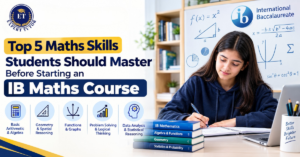
Top 5 Maths Skills Students Should Master Before Starting an IB Maths Course
Beginning an IB Maths class may seem difficult, especially since students may not have enough confidence in their understanding of basic mathematics. In an IB program, students are required to understand and interpret mathematical theories and problems in order to solve them rather than simply memorize the formula. Having good grounding in this subject makes it very easy. If the student needs some academic guidance, he can take the help of an IB Maths Tutor in Dubai who will also point out his weaknesses and strengthen his skills before starting the class. Expert Tutor works hard to help students approach academic studies in a better way.
To move towards IB Maths, one needs to be well grounded in the basic skills required. These are five of them.
1. Build Strong Algebra Skills Before Meeting an IB Maths Tutor in Dubai
Algebra forms one of the most crucial fundamentals of higher mathematics. Students who have difficulty manipulating basic algebra will find the concepts in IB Maths too challenging. Before embarking on the course, students should be able to:
- Algebraic expression simplification
- Linear equation solving
- Ability to solve simultaneous equations
- Expansion and factorization of expressions
- Working with algebraic fractions
- Value substitution into formulas
- Formula rearrangement to solve for unknown variables
- Comfort with indices and powers
For instance, the ability to rearrange equations would be helpful in cases where the unknown variable has not been isolated. Equally important, the process of factorisation would facilitate future work with quadratic equations and functions.
In addition to getting the right answer, students should pay attention to how every algebraic step was performed. The importance of such a process will grow as mathematical problems become more complicated.
2. Develop Number Skills and Calculation Accuracy
Good numerical ability might appear to be fundamental, but it affects most aspects of a maths course. Students must perform well with numerical values while maintaining precision in complex calculations.
Key components include:
- Fractions, decimals, and percentages
- Ratio and proportion
- Positive and negative numbers
- Powers and roots
- Standard form
- Order of operations
- Rounding and estimating
- Significant figures and decimal places
It is also important for learners to be able to understand when a solution is impossible. Estimation can help one check whether or not the answer provided by the calculator makes sense. If, for example, a particular calculation should yield a number in the proximity of 50 but a calculator yields 5,000 as the answer, the work should be rechecked. Accuracy is especially important when solving problems that consist of many steps. One mistake at the beginning will influence all the subsequent steps.
3. Understand Graphs, Functions, and Mathematical Relationships
Graphs play an important role in the language of mathematics. Before undertaking an IB Maths course, students should have the ability to interpret and make graphs. A sound knowledge base encompasses the following:
- Coordinates and the Cartesian plane
- Linear graphs
- Gradient and intercepts
- Quadratic graphs
- Basic transformations
- Domain and range
- Relationships between equations and graphs
- How changes in an equation affect its graph
It is also important for students to learn about functions rather than considering the graphs as just a picture. For instance, if there is any modification in the equation of a line, then the students should be able to analyze how there might be a change in its gradient or position. This will help the students deal with the problem logically. An IB maths tutor in Dubai can also provide practice questions for connecting the two forms of representation, especially when the student finds difficulty in one of them.
4. Strengthen Problem-Solving and Logical Reasoning
Knowledge of math equations alone cannot guarantee success in Mathematics. It is equally important that students should have knowledge of how to select an appropriate mathematical approach to solve a given problem. Problem solving requires a number of procedures:
- Read the question carefully.
- Identify the data given.
- Identify what needs to be worked out.
- Choose a suitable approach.
- Display the working clearly.
- Check if the answer makes sense.
Students are supposed to practice problems that will make them think instead of just following something that they already know. A good idea is to always ask yourself “What do I know?” and “What do I want to find?” before doing any calculation.
In this way, you will be able to avoid going directly for the formula without really understanding the problem. It will also make you use the language of mathematics.
5. Improve Mathematical Communication and Interpretation
Mathematics is more than just calculations; students have to explain their calculations as well.
Prior to embarking on IB Mathematics, students ought to practise:
- Logical presentation of working
- Correct mathematical notation
- Explanation of reasoning behind answers
- Understanding the meaning of results
- Graphical representation of mathematics
- Word problem interpretation
- Units where appropriate
Think about a problem which relates to distance, speed, and time. Solving the problem numerically may not be the end result. Students need to know what the number means, and whether the unit and its magnitude make sense.
Mathematical communication will also help students find their errors. With work being done step-by-step, it is easy to spot where there were wrong assumptions or wrong calculations.
How an IB Maths Tutor Dubai Can Support Better Preparation
It does not necessarily mean that a subject is too complicated for students, as sometimes there is just a little gap in understanding some previously learned things. For instance, a student who is not sure about fractions may have difficulties with algebraic fractions. One who does not understand equations will face troubles when dealing with functions. The lack of ability to interpret graphs may be an additional difficulty in comprehending some other mathematical subjects.
This is how tutors may help students realize such gaps and deal with them. They may teach students some necessary things without giving equal attention to everything that was already learned by students. Thus, preparation may be more relevant, and students will get a chance to apply their knowledge of some concepts at the right level. However, it should be noted that tutoring will be effective only if students are involved in the whole process of studying.
A Simple Preparation Checklist for IB Maths Students
Before beginning the course, students can use this checklist to review their readiness:
Skill Area |
Can You Do This Confidently? |
| Algebra | Simplify expressions and solve equations |
| Numbers | Work accurately with fractions, percentages, powers, and roots |
| Graphs | Read and interpret basic graphs |
| Functions | Understand basic input-output relationships |
| Problem-solving | Identify the correct method for a question |
| Communication | Show working and explain mathematical reasoning |
| Accuracy | Check calculations and recognise unreasonable answers |
If several areas feel difficult, students can use the time before the course begins to strengthen those foundations rather than waiting until advanced topics become challenging.
Preparing for IB Maths with Greater Confidence
Being well prepared is not about knowing everything about all topics prior to the start of a class. It is about being so proficient in the basics that one does not have to keep referring back to the calculations. It is important for students to focus especially on algebra, numeracy, graphs and functions, problem-solving, and mathematics communication skills. This will help them prepare for more difficult tasks.
Practice rather than cramming is more effective. One can begin with easier questions, work through errors, and then proceed to multi-step questions which require a good deal of reasoning. In the case of students who require academic assistance, one of the ways to prepare may be through us. It is not just about making maths easier. It is about helping students understand how to think through new tasks.
Build a Strong Foundation Before IB Maths
Preparing for IB Maths courses will be easier for students once they are sure about their foundation. Good knowledge of algebra, numbers, graphs, problem-solving, and communication of mathematics can assist them in approaching the new topic with more clarity. Practicing on a regular basis and receiving proper assistance will also make it easy for them to identify any weaknesses in the subjects beforehand. With proper preparation and expert assistance from Expert Tutor Online, the student can prepare for their IB Maths course.
Frequently Asked Questions
1. What are the Maths skills that students should possess before embarking on IB Maths?
Students must be able to comprehend concepts about algebra, numbers, graphs, functions, problem-solving, and notation.
2. What is the significance of algebra in IB Mathematics?
Algebra forms the basis of many other areas of higher mathematics. It is necessary to be able to manipulate algebraic expressions, solve equations and rearrange formulae with confidence.
3. How can students develop their Maths skills prior to the course?
Through practice, learning from errors, and improving on foundational Maths skills.
4. Is it necessary for students to have a calculator for all Math questions?
It is not necessarily required, since students must be aware of the procedure involved in Math.
5. What would students do when they find Math questions difficult?
Students could pinpoint the exact area that causes difficulty and then practice the concepts.