
How AI Coding Builds Creativity, Logic, and Analytical Thinking
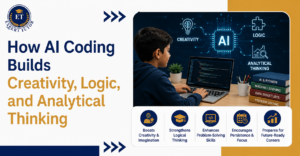
A couple of years back, programming was something that could be done only by programmers. This scenario is not at all prevalent in the present world. The present generation of students is coding applications that involve AI, working on chatbots, and solving practical life problems by using coding. It is now being understood by the parents that programming does not only involve coding, but it also means that one learns how to think.
This reason makes many families interested in an AI Coding course, as such courses assist in improving the creativity, logical, and analytical thinking of students.
Industry Insight
AI is transforming businesses, educational establishments, and even governmental organizations at an amazing speed. The technology that is now used in various spheres such as healthcare, finance, education, and transport makes organizations more advanced. As they integrate AI-powered solutions, their focus shifts to people who know how these intelligent systems work and are able to help solve difficult issues.
Nowadays, educational establishments try to introduce coding and computational thinking into education. They try to prepare flexible people who will be able to learn and use new technologies.
An AI Coding Course is one of those courses that combines both programming and logic. It allows students to not only develop applications but also analyze data and find better solutions to problems.
Expert Commentary
Experts agree that coding is fundamentally an exercise in structured thinking. Every program begins with identifying a problem, understanding possible solutions, and translating those ideas into logical instructions a computer can follow.
A high-quality AI Coding Course goes beyond teaching syntax or programming languages. It encourages students to develop skills that are transferable across academics and future careers.
Some of the most valuable abilities students gain include:
- Breaking complex problems into manageable steps.
- Recognizing patterns within large amounts of information.
- Thinking critically before making decisions.
- Testing ideas through experimentation.
- Learning from mistakes and improving solutions.
These habits mirror the way engineers, scientists, researchers, and entrepreneurs approach challenges in the real world.
Creativity also plays a significant role in AI coding. Students are encouraged to imagine solutions, design applications, and explore different ways to solve the same problem. Whether building a simple recommendation system or creating an educational chatbot, learners combine imagination with logical reasoning.
Another important benefit is resilience. Programming rarely works perfectly on the first attempt. Students learn to debug errors, revise their thinking, and persist until they find effective solutions. This mindset often translates into greater confidence when tackling academic and professional challenges.
Educators also recommend introducing AI coding gradually through practical projects rather than theoretical lectures. Hands-on activities help students connect abstract concepts with real-world applications, making learning more engaging and meaningful.
Proof & Real-World Perspective
The growing interest in AI education is not driven by trends alone. Schools, universities, and employers increasingly recognize that coding develops transferable skills that extend beyond technology careers.
For example, a student working on an AI-powered chatbot quickly learns that writing code is only one part of the process. They must first understand the user’s problem, organize information logically, test different approaches, identify errors, and continuously improve the solution. These activities naturally strengthen analytical thinking and creative problem-solving.
Similarly, students developing image recognition or recommendation projects discover that successful AI systems require patience, experimentation, and logical decision-making. Even when projects fail initially, learners gain valuable experience by refining algorithms and testing new ideas—an approach widely used by professional software developers and AI engineers.
Parents also observe practical benefits outside the classroom. Students who participate in coding activities often become more confident in mathematics, science, and logical reasoning because they regularly practice structured thinking and problem analysis.
Analysis
Why an AI Coding Course Improves Logical Thinking
Logic is the foundation of every computer program. Before writing a single line of code, students must analyze a problem, identify patterns, and determine the most efficient solution.
An AI Coding Course encourages students to think systematically by teaching them how to:
- Break large problems into smaller tasks.
- Organize ideas logically.
- Recognize patterns in data.
- Make evidence-based decisions.
- Evaluate multiple possible solutions.
These abilities are equally valuable in academic subjects such as Mathematics, Physics, and Computer Science, where structured reasoning leads to stronger performance.
Rather than memorizing answers, students learn how to think independently—a skill that remains useful throughout higher education and future careers.
How an AI Coding Course Encourages Creativity Through Innovation
Creativity is often associated with art and design, but it is equally important in technology.
Every coding project begins with a question:
“How can I solve this problem differently?”
Students are encouraged to:
- Design their own applications.
- Create unique user experiences.
- Experiment with different programming methods.
- Build practical AI solutions.
- Improve existing ideas through innovation.
For instance, two students may receive the same project brief but develop completely different solutions. One might build an educational quiz application, while another creates an AI-powered study assistant. Both demonstrate creativity while applying the same technical principles.
This combination of imagination and logic makes AI coding one of the most engaging learning experiences available today.
Common Challenges Students Face While Learning AI Coding
Although AI coding offers numerous benefits, beginners sometimes encounter obstacles that can slow their progress.
Some common challenges include:
- Trying to memorize programming syntax instead of understanding concepts.
- Becoming discouraged after encountering coding errors.
- Rushing through projects without proper planning.
- Depending heavily on tutorials instead of practicing independently.
- Expecting immediate results without consistent effort.
These challenges are completely normal. Experienced instructors help students overcome them through structured guidance, regular feedback, and project-based learning that builds confidence gradually.
Recommendations
Students interested in AI coding should focus on developing strong fundamentals before exploring advanced technologies.
Experts recommend:
- Learning one programming concept thoroughly before moving to the next.
- Building small practical projects regularly.
- Practicing problem-solving rather than memorizing code.
- Asking questions whenever concepts are unclear.
- Collaborating with experienced mentors who provide constructive feedback.
Parents should also evaluate AI programs carefully before enrolling their children.
A quality course should include:
- Age-appropriate curriculum
- Hands-on coding projects
- Experienced instructors
- Interactive learning sessions
- Real-world AI applications
- Regular progress assessments
Choosing a structured learning environment helps students remain motivated while developing practical skills that support long-term success.
Closing Thoughts
Artificial intelligence is reshaping industries across the world, but its greatest educational value lies in teaching students how to think rather than simply how to code. An AI Coding Course strengthens creativity, logical reasoning, analytical thinking, and problem-solving through practical, project-based learning that prepares students for future academic and professional challenges. These abilities remain valuable regardless of whether a student pursues technology, business, healthcare, engineering, or entrepreneurship. Through expert guidance, hands-on projects, and personalized learning, Expert Tutor Online helps students build future-ready skills while developing the confidence to innovate, solve problems, and succeed in an increasingly AI-driven world.